What Is Good Customer Service? A 7-Point Checklist for Local Businesses
What is good customer service for a local business? Use this 7-point checklist to improve speed, clarity, handoff, and booking-ready support.
 Leo Lee10 min read
Good customer service is not just being friendly.
For a local business, good customer service means the customer can get the right answer, understand the next step, and reach a person when judgment is needed without feeling ignored, trapped, or pushed around.
That sounds simple. In practice, it is where many small teams struggle.
A med spa is with a client. A salon is in the middle of color. A wellness clinic is running appointments back to back. A home service owner is on a job site. The customer is not trying to be difficult. They are asking, "Do you offer this?", "How much is it?", "Which option should I book?", or "Can someone get back to me?"
Good service is what happens before that question turns into silence.
Quick answer: good customer service removes friction
Good customer service has seven parts:
- Clarity: the customer knows what you offer and what to do next.
- Speed: simple questions do not sit unanswered.
- Accuracy: answers match your real policies, prices, hours, and services.
- Empathy: the response sounds like it understands the customer's situation.
- Next-step guidance: the customer is not left with a vague answer.
- Human handoff: sensitive or unclear questions reach the right person.
- Follow-through: the business does what it said it would do.
Most customer service software companies define customer service broadly as support before, during, and after a purchase. Salesforce describes customer service as the support a business provides before and after customers buy or use its products or services, while Zendesk's customer service guide emphasizes helpful, convenient, and consistent support across the customer journey.
For a small local business, the same idea becomes more concrete:
Good customer service means customers do not have to work hard to understand whether your business can help them.
Source links in this article were checked May 18, 2026.
The 3-minute customer service self-audit
Before you change tools, answer these seven questions.
| Question | If the answer is no |
|---|---|
| Can a new visitor understand what you do in under one minute? | Your website needs clearer service language. |
| Can they find the right booking, quote, or contact path? | Your next step is too buried or too vague. |
| Do common questions get answered the same way every time? | Your team needs approved answers or better source content. |
| Can customers get basic help after hours? | You are likely losing warm inquiries while closed. |
| Does your team know what to do with uncertain questions? | You need routing and handoff rules. |
| Can upset customers reach a person without fighting the system? | Your service process may feel defensive or automated. |
| Do you review repeated questions and fix the source problem? | You are answering symptoms instead of improving the experience. |
If you fail one or two, that is normal. If you fail most of them, the issue is not only "customer service." It is the path from customer question to customer action.
That is the path a local business should improve first.
The 7-point good customer service checklist
Use this checklist to define practical customer service standards for small business before you automate anything.
| Standard | What the customer wants | Website or support check | Where AI can help | Keep human |
|---|---|---|---|---|
| Clarity | "Can you help me?" | Services, prices, policies, and next steps are easy to understand. | Answer from approved pages and FAQs. | Unclear fit, sensitive advice, or regulated questions. |
| Speed | "Will anyone answer me?" | Common questions have a fast first response. | Reply instantly to simple website questions. | Urgent, emotional, or complex situations. |
| Accuracy | "Can I trust this answer?" | Answers match current business information. | Use source-based responses only. | Anything not in the source or not verified. |
| Empathy | "Do you understand what I need?" | Responses acknowledge the customer's situation. | Use calm, helpful language and ask for context. | Upset customers and relationship repair. |
| Next-step guidance | "What do I do now?" | Every answer points to booking, quote, call, contact, or follow-up. | Route to the right path. | Final decisions or commitments. |
| Human handoff | "Can I talk to someone?" | Customers can reach staff when needed. | Collect context and explain the best contact path. | Refunds, exceptions, complaints, eligibility, exact quotes. |
| Follow-through | "Will this actually happen?" | The team follows up on captured inquiries. | Summarize and organize intake details. | The actual promise, confirmation, or resolution. |
The checklist is intentionally practical. Good customer service is not a slogan. It is a set of behaviors the customer can feel.
1. Clarity: customers should not need to decode your business
Bad customer service often starts before anyone sends a message.
If the website says "advanced treatments," "customized solutions," or "premium services" but does not explain what the customer should book, the customer has to guess.
That creates questions like:
- "Do you offer this?"
- "Is this for new clients?"
- "Do I need a consultation first?"
- "Which appointment should I choose?"
- "Can I get a quote before booking?"
Good service makes the next step obvious. A med spa visitor should know whether to book a consult. A salon client should understand whether a color correction needs review first. A wellness visitor should know what a first appointment includes.
Clear service language is customer service.
It reduces anxiety before the customer ever talks to you.
2. Speed: fast does not mean careless
Speed matters because customer questions usually happen at decision points.
Someone asks about pricing because they are deciding whether to book. Someone asks about availability because they are comparing options. Someone asks whether you serve their area because they do not want to waste time.
For a large company, speed might mean staffing more channels. For a local business, speed usually means having a reliable first response for common questions.
Good fast service sounds like this:
We can help with that. Here is the general information, and here is the best next step.
Bad fast service sounds like this:
Sure, that should work.
The second answer is fast but unsafe. Good service is not just speed. It is fast enough to be useful and careful enough to be trusted.
3. Accuracy: the answer should match the real business
Customers forgive a little waiting more easily than they forgive a confident wrong answer.
For local businesses, accuracy usually means:
- current hours
- real service names
- correct booking links
- current price ranges or quote rules
- actual cancellation policies
- real service areas
- clear preparation instructions
This is why your website, FAQ, and booking pages matter. They are not just marketing content. They are the source your team, and any AI Support Agent, should use to answer customers consistently.
If the source is messy, the service will be messy.
Before automating customer support, clean up the answers your business already wants to stand behind. The customer support automation priority map is useful when you are deciding which answers are safe enough to automate first.
4. Empathy: customers want to feel understood, not managed
Empathy does not require long emotional language.
It means the response fits the customer's situation.
If someone asks, "How much is lip filler?", they may be asking about budget, surprise fees, consultation requirements, and whether booking is worth it. If someone asks, "Can beginners join?", they may be worried about feeling embarrassed. If someone asks, "Can someone call me back?", they may already be frustrated by not getting an answer.
Good service reflects that context:
If you are not sure which option to book, starting with a consultation is the safest path.
That is better than:
Please see our services page.
Both may be technically correct. Only one feels helpful.
5. Next-step guidance: do not end with information alone
Information is useful only if it helps the customer act.
Good customer service usually ends with one of these next steps:
- book online
- request a quote
- start with a consultation
- call the team
- send photos or details
- complete an intake form
- wait for a staff follow-up
This matters because many local business questions are pre-booking questions. They sound like support, but they are often the final hesitation before a customer takes action.
Bad answer:
We offer consultations.
Better answer:
Yes, new clients usually start with a consultation. You can book that here, or send us your question first if you are unsure.
The better answer does not just inform. It moves the customer forward.
6. Human handoff: good service knows when automation should stop
Good customer service is not measured by how long you can keep someone inside a workflow.
Sometimes the best service is a clean handoff.
Keep these human:
- refunds
- complaints
- policy exceptions
- medical, legal, financial, or safety advice
- eligibility decisions
- exact quotes without review
- outcome guarantees
- emotionally charged situations
Bad handoff:
I cannot help with that.
Better handoff:
This needs a team member to review it. Please share your name, contact details, and what happened so the right person can follow up.
That is still efficient. It is also more respectful.
If you are using AI, this boundary is especially important. The U.S. Small Business Administration's AI guidance recommends starting small, reviewing AI output, and keeping customer trust in mind. For customer service, that means AI should support the handoff, not hide it.
7. Follow-through: the service is not finished when the message is sent
Good service does not stop at the first response.
If your website collects a quote request but nobody follows up, the customer does not care that the form worked. If a chatbot collects a phone number but the team never sees the summary, the customer still feels ignored. If staff say "we will call tomorrow" and do not call, the service failed.
Follow-through is where small businesses can outperform larger teams.
You do not need a giant support operation. You need a reliable loop:
- Customer asks.
- Business answers or collects the right details.
- The right person follows up.
- The business reviews repeated questions and improves the source content.
That loop turns customer service from reaction into operating discipline.
Good vs bad customer service examples
Here are a few practical examples.
| Situation | Weak service | Better service |
|---|---|---|
| Price question | "Prices vary." | "Pricing depends on the service details. Here is the starting range and the best way to get an exact answer." |
| Booking confusion | "Use the booking link." | "If you are new, start with this consultation. If you know the service, book here." |
| After-hours message | No response until morning. | "The team is not live now, but you can send your question and contact details here." |
| Complaint | "That is our policy." | "I am sorry this happened. Please share the appointment details so the team can review it." |
| Unclear service fit | "Yes, we do that." | "We may be able to help. The safest next step is to send details or book a consult." |
The pattern is not complicated. Better service is more specific, more careful, and more action-oriented.
Where AI fits without lowering service quality
AI can help with good customer service when it improves the checklist, not when it replaces it.
For a local business website, an AI Support Agent can help by:
- answering common questions from approved content
- keeping first responses available after hours
- routing customers to booking, quote, call, or contact paths
- collecting details before a human follows up
- summarizing what the customer asked
- refusing to answer questions that need judgment
That is different from saying AI should handle everything.
If your business is still asking whether AI belongs in customer service at all, this AI customer service for small business guide explains why the website is usually the safest place to start. If you want concrete examples, use the AI customer service use cases list.
CatchWhen fits when the problem is website inquiries: people ask questions before booking, requesting a quote, or contacting the team, and you want a safer first-response layer that uses your approved content and routes customers to the next step.
The goal is not to make service feel automated. The goal is to make good service more consistent when your team is busy.
FAQ
What is good customer service in simple terms?
Good customer service means helping customers get the right answer, next step, or human support without unnecessary friction. For local businesses, that often means clear service information, fast first response, accurate answers, and reliable follow-up.
What are examples of good customer service?
Examples include answering common questions quickly, explaining which appointment to book, giving realistic price guidance, collecting quote details before a callback, and routing sensitive issues to a person instead of forcing customers through automation.
What makes customer service bad?
Bad customer service usually feels vague, slow, inconsistent, defensive, or impossible to escape. A customer should not have to repeat themselves, chase the business, or accept a confident answer that the business cannot actually stand behind.
Can AI improve customer service?
Yes, when it is used for the right jobs. AI can answer common questions, collect details, and route visitors to the right next step. It should not handle judgment-heavy issues like complaints, refunds, policy exceptions, eligibility decisions, or exact quotes without human review.
Takeaway
Good customer service is not just a nice tone.
It is a practical system: clear answers, fast response, accurate source content, useful next steps, human handoff, and real follow-through.
For local businesses, the best customer service often starts before the customer calls. It starts when the website makes the next step easy.

Article by
Leo Lee
Leo Lee is the founder and builder of CatchWhen, a Customer Support AI System that creates AI Support Agents for appointment-based local businesses. CatchWhen helps med spas, salons, wellness clinics, and other independent service businesses answer customer-facing website inquiries and route ready leads into the booking, quote, or contact tools they already use. Leo writes about the workflows, guardrails, and infrastructure behind production-ready AI customer support agents.
Keep reading
AI Chatbot for Small Local Businesses: A Practical Website Guide
A practical guide to AI chatbots for small business websites: what they answer, where they fit, and how local owners route visitors to booking or quote links.
 Leo Lee
AI Chatbot for Med Spas: Route More Consult Requests from Your Website
A practical guide to med spa website chatbots: answer Botox, filler, laser, pricing, and consult questions, then route visitors to your existing booking path.
Leo Lee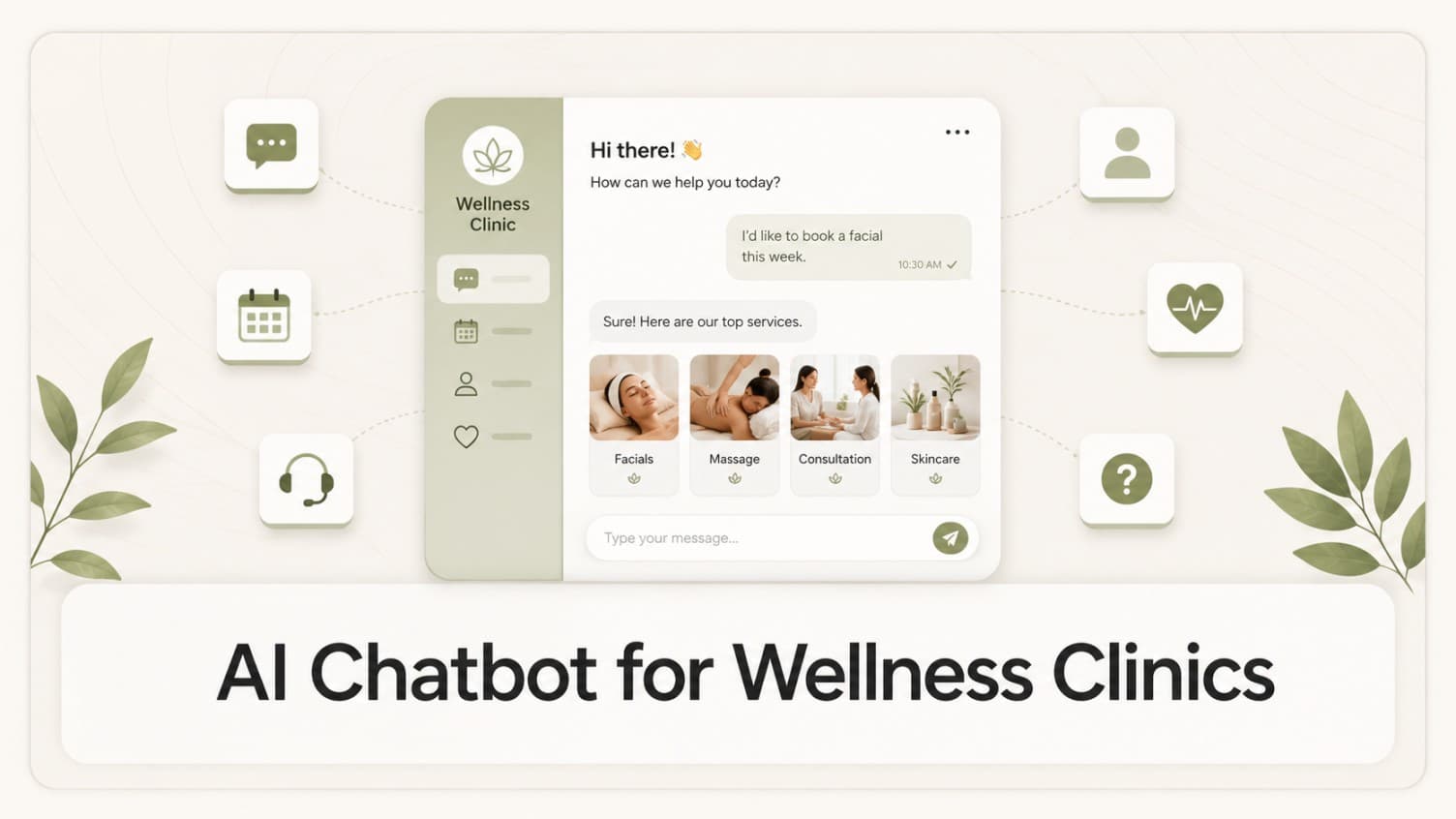
AI Chatbot for Wellness Clinics: Answer First-Visit Questions Faster
A practical guide to wellness clinic website chatbots: answer physio, chiro, massage, pilates, yoga, and IV drip first-visit questions, then route ready visitors to booking or intake.
Leo Lee