Salon Website FAQ Examples That Help Clients Book Faster
Practical salon website FAQ examples for booking, pricing, color, extensions, and policies, with weak vs better rewrites and safer chatbot routing.
 Leo Lee11 min read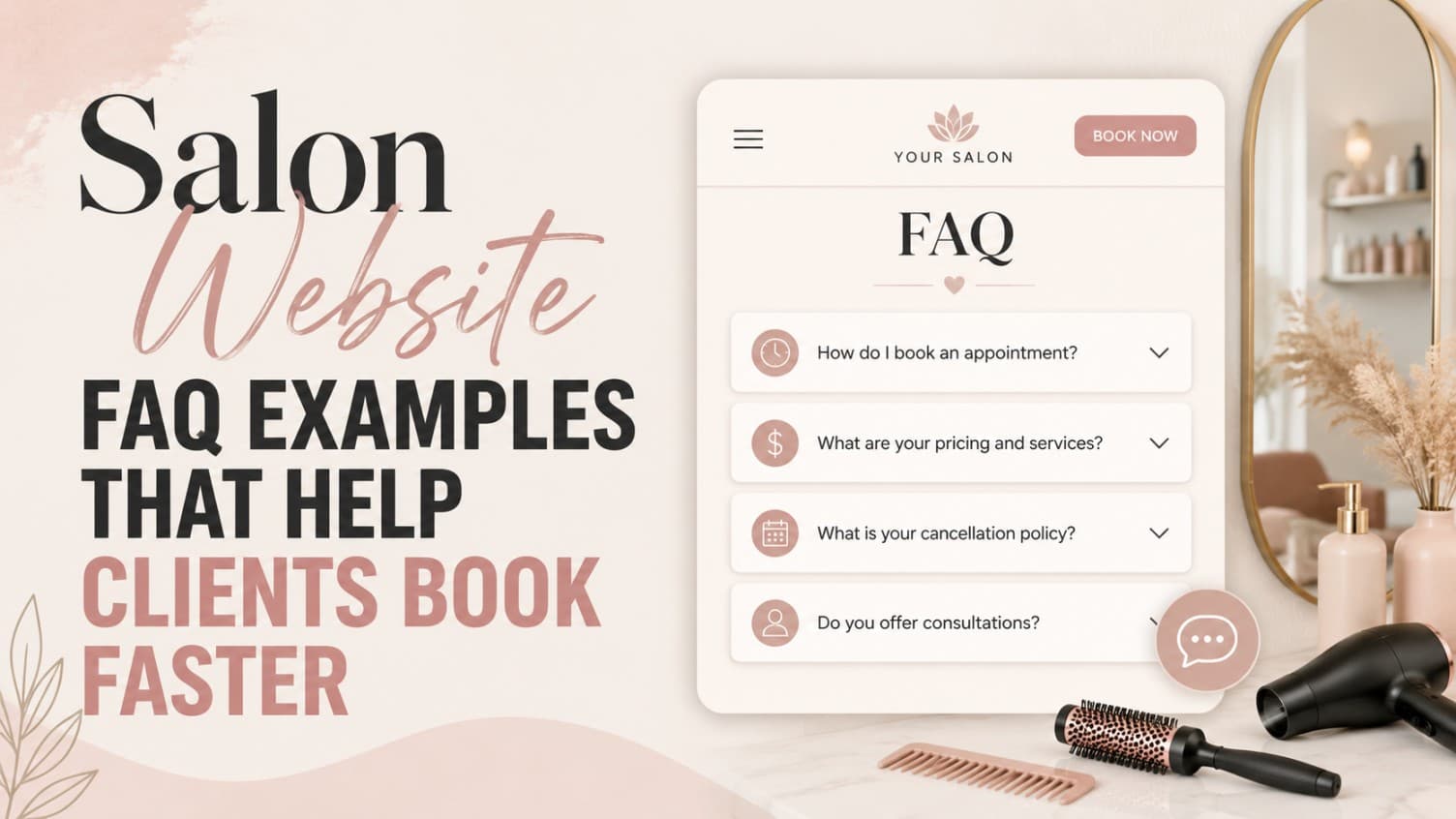
Most salon FAQ pages read like a service menu with extra steps.
They define balayage, list hours, and link a price sheet. But the visitor who opens the FAQ at 10pm is rarely asking for definitions. They are asking something closer to: "I don't know what to book.", "How much will this cost for my hair?", "Do you take new clients?", or "What happens if I'm running late?"
The salon website FAQ examples below are built around those moments. Each category starts with a weak answer you have probably seen on a real salon site, then a better version that answers plainly, sets a boundary where stylist judgment matters, and routes the client to the next step.
Use them as starting points. Your service names, prices, and policies should replace the placeholders before anything goes live on a website or chatbot.
Quick answer
A good salon FAQ does three jobs:
- Answer the practical question in plain language, without assuming the client knows salon terminology.
- Set a boundary when the real answer depends on a consultation, hair history, or a stylist's assessment.
- Route the client to a clear next step: the booking page, a consultation, a call, or a message to the team.
Salon FAQs also have a fourth job most industries do not: translating the service menu. A med spa visitor usually knows they want Botox. A salon visitor often cannot tell whether they need a partial highlight, a full highlight, a gloss, or a color correction. If your FAQ does not help them pick, they either book the wrong service or leave.
If you are deciding between a FAQ page and a chatbot, you do not have to choose; the FAQ becomes the chatbot's training material. That comparison is covered in FAQ Page vs AI Chatbot.
Why most salon FAQ pages do not help clients book
Salon FAQ pages usually fail in four ways.
They speak menu, not client. "We offer balayage, babylights, and dimensional color" means nothing to someone whose actual question is "my blonde looks brassy, what do I book?"
They hide pricing behind "it varies." Pricing can vary and still be explained. Length, density, current color, and stylist level are factors a client can understand in one sentence.
They bury the policies that cause day-of friction. Deposits, late arrivals, kids, and redo rules generate more front-desk tension than any styling question, yet they often live in a booking-tool footnote.
They answer without routing. The client gets an answer, then has to hunt for the booking link again. Every answer should end with a next step.
The five question types salon visitors actually ask
Most pre-booking salon questions fit into five groups.
| Question type | What the client really wants to know | Best route |
|---|---|---|
| Service fit | "Which service on your menu matches my hair situation?" | Booking category, consultation, or staff contact. |
| Price | "Roughly what will this cost for my hair, and what changes the price?" | Pricing guidance, consultation, or quote request. |
| Logistics | "How do I book, when should I arrive, should I wash my hair first?" | Booking link, prep instructions, or contact path. |
| Policy | "What are the rules on deposits, lateness, kids, and fixes?" | Policy page or booking page where rules appear. |
| Expectations | "How long will it take, and is my goal realistic in one visit?" | Service page, consultation, or stylist review. |
Service fit is the group most salon FAQs skip entirely, and it is the one that loses the most bookings. The client who cannot pick a service does not call to ask. They close the tab.
Use this rewrite formula
For every FAQ, write three parts:
Answer first. Give the clearest safe answer in one or two sentences, in the client's words.
Add the boundary. Say what depends on hair history, length, condition, or a stylist's in-person assessment.
Route the next step. Name the exact action: book online, request a consultation, call, or message the salon.
Example:
Question: How much is balayage?
Weak answer: Pricing varies. Please contact us for details.
Better answer: Balayage starts at a base price that depends on your hair length, density, and current color. Lived-in color over previously dyed or very long hair takes more time and product, so the stylist confirms the final price at your consultation before any work starts.
Route: Book a color consultation or see the service menu for starting prices.
The weak answer is not wrong. It just transfers the work back to the client. The better answer gives a real explanation and keeps the price honest without inventing a number.
Booking and new-client FAQ examples
New-client questions are the easiest wins because the answers rarely depend on stylist judgment.
Do you take new clients?
Say it directly. If some stylists are waitlist-only, explain how new clients get matched.
Weak: "Contact us for availability."
Better: "Yes, new clients are welcome. Most services can be booked online, and if your preferred stylist is waitlisted, the booking page will show which stylists have new-client openings."
Route: Online booking page.
How far in advance should I book?
Give your real lead time by service type if you can. Color and extensions usually need more notice than cuts.
Route: Booking link, with a note to call for short-notice openings.
Should I wash my hair before my appointment?
This is one of the most searched salon questions, and the answer differs by service. State your salon's preference for cuts, color, and styling, and say when arriving with product-free or dry hair matters.
Route: Prep instructions or the booking confirmation email.
Can I book with a specific stylist?
Explain how stylist selection works in your booking tool and whether stylist levels affect price.
Route: Booking link with stylist selection.
Pricing FAQ examples
Vague pricing answers lose clients who were ready to book. You do not need exact numbers to be useful.
Why do your prices say "starting at"?
Weak: "Final pricing is determined at the salon."
Better: "Starting prices cover the base service. Hair length, density, the amount of product needed, and stylist experience level can add to the total. Your stylist confirms the price before starting, so there are no surprises at checkout."
Route: Service menu or consultation.
Do you charge more for long or thick hair?
If yes, say so plainly and explain why: more time and more product. Clients accept length-based pricing far better than discovering it at the register.
Route: Pricing page or quote request.
Can I get a quote before booking?
Be honest about what the team can estimate from photos or a message and what needs an in-person look. Tell the client exactly what to send: current hair photos in natural light, hair history, and the goal photo.
Route: Contact form, consultation booking, or DM instructions.
Color and chemical service FAQ examples
Color questions carry the most risk of overpromising. The FAQ should make the consultation feel like the fast path, not a gate.
My color looks brassy. What should I book?
This is a service-fit question disguised as a color question.
Weak: "We offer toners, glosses, and color corrections."
Better: "If your blonde has turned yellow or orange between visits, a toner or gloss appointment usually refreshes it. If the color is uneven, very dark, or was done with box dye, book a color consultation instead so the stylist can recommend the right service and timing."
Route: Toner/gloss booking or color consultation.
Can you fix my box dye in one visit?
Do not promise outcomes. Explain that corrections depend on hair history and condition, and that the stylist needs to see the hair before giving a plan or a price.
Route: Color correction consultation.
Do I need a patch test before color?
State your salon's policy clearly, especially for first-time color clients. A cautious policy is easy to defend: the FDA's consumer guidance on hair dye recommends patch testing dye on skin and waiting 48 hours before use.
Route: Policy page or booking notes.
Do you tint eyebrows or eyelashes?
Answer only with your salon's approved service language, and keep product questions with your team. The FDA notes that coal-tar hair dyes are not permitted for eyebrow or eyelash dyeing and have caused eye injuries, so this is not an answer a website or chatbot should improvise.
Route: Service page if offered, or staff contact.
Source links in this section were checked June 11, 2026.
Extensions, lash, and nail FAQ examples
Specialty services create repeat-visit questions that confuse new clients more than the services themselves.
Do I book a fill or a full set?
Weak: "Fills are for existing extensions."
Better: "Book a fill if you have enough healthy extensions left from your last set, usually within two to three weeks. If it has been longer, or most extensions have grown out, a full set gives a better result. If you are not sure, send us a photo and we will tell you which to book."
Route: Booking category or photo message.
Do you do fills over another salon's work?
Many studios have rules about foreign fills. State the policy and the reason: the stylist needs to assess the existing application first.
Route: Consultation or staff contact.
Can you remove or repair extensions you did not install?
Same pattern: state whether you offer it, what the assessment looks like, and what is bookable online versus consult-first.
Route: Removal service page or consultation.
Do you fix broken nails between appointments?
Explain repair pricing, whether repairs from other salons are accepted, and how to book a short repair slot.
Route: Repair booking or call.
Policy FAQ examples
Policy FAQs are not glamorous, but they prevent the conversations nobody enjoys at the front desk.
What is your cancellation policy?
State the notice window, the fee, and how rescheduling works. Put the policy where booking happens, not only in the FAQ.
Route: Booking page or policy page.
Do you require a deposit?
Weak: "Deposits may be required for some services."
Better: "Color, extensions, and appointments over two hours require a deposit that applies to your service total. The booking page shows the exact amount before you confirm."
Route: Booking page.
What if I am running late?
Give the grace window and what happens after it: shortened service or rescheduling. Clients respect a clear rule more than a vague one applied inconsistently.
Route: Contact number to notify the salon.
Can I bring my kids to my appointment?
Whatever your policy is, explain the reason in one sentence: chemical services and shears make the floor unsafe for unsupervised children, or your salon welcomes them in certain areas. Plain reasoning prevents the policy from reading as unfriendly.
Route: Policy page.
What if I do not love my hair?
A redo or adjustment policy is one of the most trust-building FAQs a salon can publish. State the window for adjustments, what counts as an adjustment versus a new service, and how to start the conversation.
Route: Contact the salon directly.
What not to put in a salon FAQ
A FAQ builds trust by knowing its limits. Avoid these patterns:
- Promising exact color results from a written description or a photo
- Quoting open appointment times when the page has no live calendar connection
- Making exceptions to deposit, late, or cancellation policies in the answer itself
- Diagnosing hair condition or damage from a chat message
- Guaranteeing a specific stylist without the booking system confirming it
- Listing thirty questions when ten cover the real booking blockers
- "Contact us" as the entire answer to every pricing question
The riskiest FAQ is not the one that says "ask the stylist." It is the one that sounds confident past the point where a professional should take over.
How to use these FAQs in a chatbot
If your website has a chatbot, the FAQ page stops being static content and becomes its working knowledge.
Train the chatbot on:
- Approved service descriptions in client language, including which service fits which situation
- Starting prices, pricing factors, or approved "priced at consultation" wording
- Deposit, cancellation, late, kids, and redo policies
- New-client instructions and prep guidance
- Booking links by service category, plus phone, email, and contact paths
- Which questions must route to a stylist: corrections, condition assessments, foreign fills, tinting products
Then test with the questions clients actually send: "How much is balayage for long hair?", "Can you fix my box dye?", "Do I book a fill or a full set?", "Do you have anything Saturday?" The chatbot should answer the first three from your approved content and route the fourth to the booking tool instead of guessing availability.
CatchWhen's Website Support Agent is built for exactly this layer: it answers from your trained FAQ and service content, keeps the boundaries you set, and routes ready clients to the booking link you already use. For the full salon workflow, read AI Chatbot for Salons. For setup, see the website embed guide, and for plans, see CatchWhen pricing.
A stronger salon FAQ checklist
Before publishing, check each FAQ against this list:
- Does it answer a question clients actually ask, in their words?
- Does it help a confused client pick the right service?
- Does it explain pricing factors instead of hiding behind "it varies"?
- Does it state the boundary where a stylist needs to assess in person?
- Does it end with a specific next step and a working link?
- Does it match what the front desk actually says on the phone?
- Would it still be accurate if your prices changed next month, or is it dated?
- Does it avoid promising results, availability, or exceptions?
If an answer does not help someone book, prepare, or trust the salon, it probably belongs on a service page instead of the FAQ.
Salon website FAQ examples FAQ
Should a salon publish prices on its FAQ page?
Publish starting prices or ranges if they are approved and maintained. If exact pricing depends on length, density, or a consultation, explain those factors plainly and route to a consultation or quote request instead of staying vague. Clients leave over silence more than over honest ranges.
How many FAQs should a salon website have?
Around eight to fifteen focused questions usually beat a long archive. Cover service fit, pricing factors, booking logistics, and the policies that cause day-of friction. Move long answers to service or policy pages and link them from the FAQ.
Can I use these FAQ examples in an AI chatbot?
Yes, after replacing the placeholders with your real services, prices, policies, and booking links. The chatbot should answer common questions from your approved wording and route corrections, condition assessments, and availability checks to the right path instead of improvising.
The practical takeaway
Salon website FAQ examples are only useful if they reflect how clients actually get stuck.
The client is not asking for a glossary. They are trying to figure out which service to book, what it roughly costs, what the rules are, and whether your salon will treat their hair, and their time, with care.
Write each FAQ to answer plainly, hold the boundary where stylist judgment belongs, and route to the next step.
The FAQ page that does that is not just content. It is your front desk, answering at 10pm.

Article by
Leo Lee
Leo Lee is the founder and builder of CatchWhen, a Customer Support AI System that creates AI Support Agents for appointment-based local businesses. CatchWhen helps med spas, salons, wellness clinics, and other independent service businesses answer customer-facing website inquiries and route ready leads into the booking, quote, or contact tools they already use. Leo writes about the workflows, guardrails, and infrastructure behind production-ready AI customer support agents.
Keep reading

AI Chatbot for Small Local Businesses: A Practical Website Guide
A practical guide to AI chatbots for small business websites: what they answer, where they fit, and how local owners route visitors to booking or quote links.
 Leo Lee
AI Chatbot for Med Spas: Route More Consult Requests from Your Website
A practical guide to med spa website chatbots: answer Botox, filler, laser, pricing, and consult questions, then route visitors to your existing booking path.
Leo Lee
AI Chatbot for Wellness Clinics: Answer First-Visit Questions Faster
A practical guide to wellness clinic website chatbots: answer physio, chiro, massage, pilates, yoga, and IV drip first-visit questions, then route ready visitors to booking or intake.
Leo Lee