AI Search vs Google Maps: Where Should Local Businesses Focus First in 2026?
Compare AI Search vs Google Maps for local businesses in 2026 with a focus-first decision matrix, examples, and a 30-day visibility plan.
 Leo Lee12 min read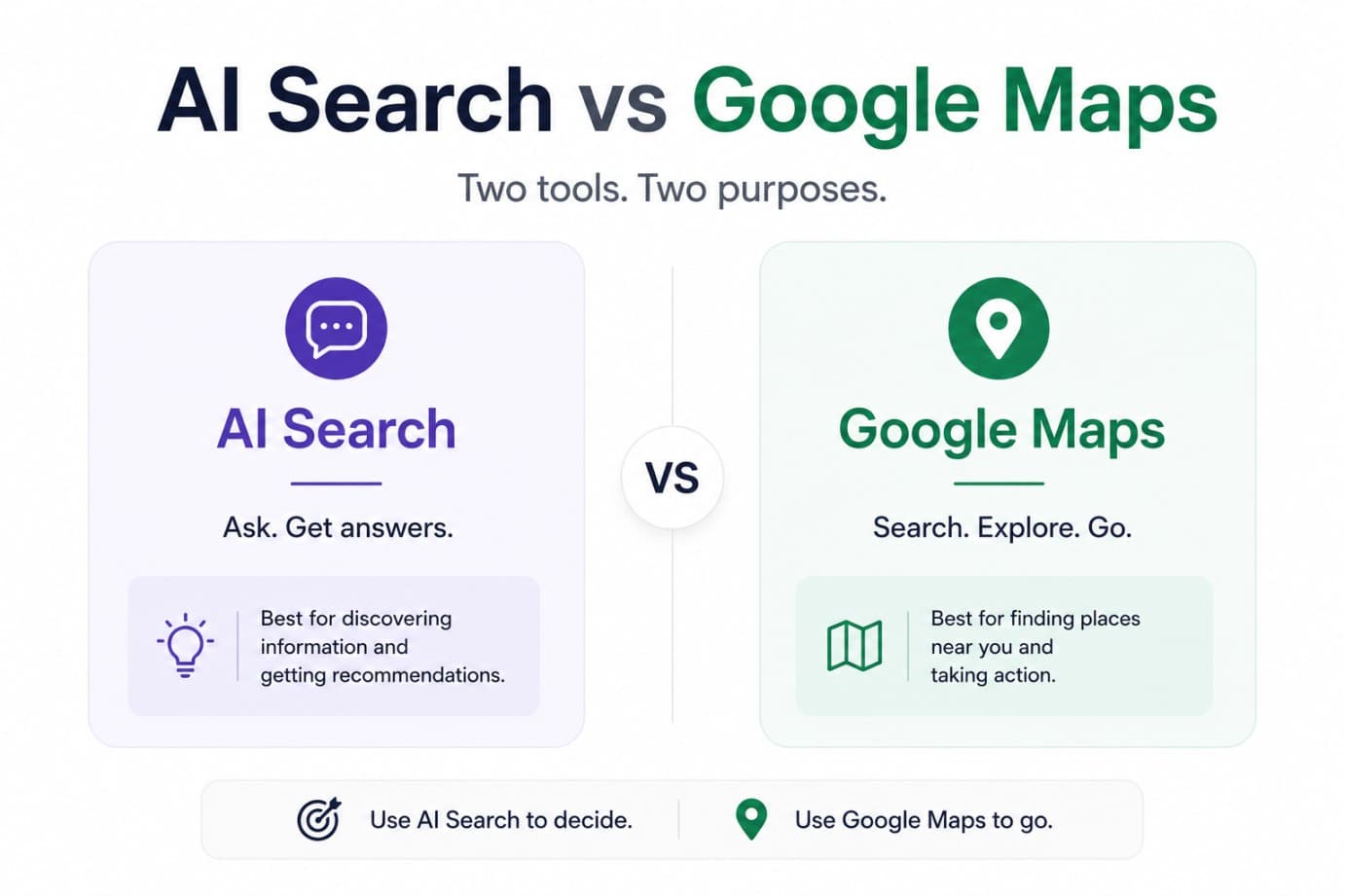
AI Search and Google Maps solve different local business problems.
Google Maps is still the most direct action surface when someone wants a nearby business, directions, hours, reviews, a phone number, or a place to book or visit.
AI Search is becoming more important when someone asks a broader question: "Who should I choose?", "Which place is best for my situation?", "What should I know before booking?", or "Compare these options for me."
So the practical answer to AI Search vs Google Maps for a local business is this: fix Google Maps and Google Business Profile first if your basic local visibility is weak. Build AI Search visibility in parallel by making your website, reviews, and public business information specific enough for AI tools and customers to verify.
Do not treat this as a choice between old search and new search. In 2026, customers move across both.
Quick answer: where should you focus first?
If your Google Business Profile is incomplete, unverified, stale, or inconsistent with your website, start there.
If your profile is already accurate and customers are asking comparison-style questions, build the AI Search layer next.
Use this order:
- Google Maps / Google Business Profile: fix name, category, hours, services, location, photos, website link, and reviews.
- Website source content: make service pages, FAQs, location/service-area details, and booking or quote paths clear.
- AI Search testing: run prompts in ChatGPT, Gemini, Perplexity, Copilot, Google AI features, and Ask Maps when available.
- Review and citation consistency: make sure public sources tell the same story.
Google's Business Profile help says local results on Google are mainly based on relevance, distance, and prominence. It also says complete and accurate information helps customers know what you do, where you are, and when they can visit. Source checked June 1, 2026: Google tips to improve local ranking.
Google Search Central says AI Overviews and AI Mode surface links to help people explore, and it recommends making important content available in textual form, keeping structured data aligned with visible text, and keeping Business Profile information up to date. Source checked June 1, 2026: Google AI features and your website.
That is the operating model: Google Maps handles much of the local action. AI Search shapes research, comparison, and confidence before or after someone checks Maps.
What Google Maps is best at
Google Maps is strongest when the customer has local intent and wants to act.
They might search:
- "hair salon near me open today"
- "chiropractor near downtown"
- "med spa consultation near me"
- "pilates studio with evening classes"
- "contractor near me for a small project"
Those are not abstract research questions. They are location and action questions.
Maps and Google Business Profile matter because they show:
- whether the business exists and is verified
- where it is located or what area it serves
- whether it is open
- how to call, navigate, book, or visit
- what customers say in reviews
- what category and services Google understands
- whether the business looks current through photos and profile details
For many local businesses, Google Maps is the shortest path between discovery and action.
This is especially true for walk-in, appointment, and "near me" searches. A customer choosing a salon, clinic, studio, restaurant, repair shop, or local service often wants proof and a next step quickly. Maps gives them the phone button, directions, hours, reviews, photos, and website link in one place.
The weakness is that Maps is not always enough for more complex decisions.
A profile can tell someone that a med spa exists. It may not explain whether a consultation is required before treatment. It can show a wellness clinic's hours. It may not answer what happens during a first visit. It can show a quote-based business nearby. It may not explain what details the business needs before a quote.
That is where website content and AI Search start to matter more.
What AI Search is best at
AI Search is strongest when the customer asks a question that needs interpretation.
They might ask:
- "Which local facial place is good for a first-time client?"
- "Compare these two clinics for a first visit."
- "Where should I go if I am nervous about trying Pilates?"
- "Who is good for a small project and clear quote process?"
- "What questions should I ask before booking a consultation?"
Those are not just map queries. They are decision queries.
Google has also started making Maps more conversational. Google announced Ask Maps as a Gemini-powered conversational experience that can answer complex real-world questions with a customized map. Source checked June 1, 2026: Google reimagining Maps with Gemini.
Google Search's 2026 updates also show the broader direction: AI Mode, follow-up questions from AI Overviews, and Search agents. Source checked June 1, 2026: Google Search I/O 2026 updates.
The important point for a local business is not "AI replaces Maps." It is that AI changes how customers ask for help.
AI Search may look across:
- website service pages
- Google Business Profile details
- reviews
- local directories
- social profiles
- citations
- articles and third-party lists
- visible FAQs and policy pages
Some tools cite sources. Some summarize without showing every source. Some may use a user's location context. Some may be wrong.
That means your job is not to trick one answer engine. Your job is to make the public record of your business clear enough that AI tools and customers can check it.
For the broader audit, use the AI search checklist for local businesses. This article is about priority: Maps first, AI Search first, or both.
The focus-first decision matrix
Use this matrix when time is limited.
| Your current problem | Focus first | Why |
|---|---|---|
| Your hours, phone, category, services, or address are wrong online | Google Maps / Google Business Profile | AI visibility cannot fix bad business data. |
| Customers search "near me," "open now," or "directions" before choosing | Google Maps / Google Business Profile | The action surface matters most. |
| You have few recent reviews or do not reply to reviews | Google Maps and reviews | Reviews affect trust and can support local prominence. |
| AI tools mention competitors but not you for comparison questions | Website source content plus AI Search testing | AI may not understand what you do or who you fit. |
| Your services need explanation before someone books | Website service pages and FAQs | AI and customers both need approved source material. |
| Your business is appointment, consultation, or quote-based | Both | Maps gets the customer to you; AI Search and website content help them choose the right next step. |
| Your website gets visitors but they still ask basic questions | Website source content and Website Support Agent | The discovery worked, but the site is leaking the moment. |
| You only have three hours this week | Google Business Profile basics first | Fixing the public profile usually removes the biggest local-data risk. |
The default recommendation is simple:
Start with Google Maps if the business facts are wrong. Start with AI Search content if the facts are right but customers still cannot understand why to choose you.
Most businesses need both, but not at the same intensity every week.
What to fix first in Google Maps
Google Maps work should not start with posting random updates.
Start with facts.
Check these in Google Business Profile:
| Area | What to verify | Bad signal |
|---|---|---|
| Business name | Real-world business name matches signs, website, and listings | Extra keywords stuffed into the name |
| Primary category | The category matches what customers actually search for | Too broad, outdated, or wrong category |
| Services | Main services are listed clearly | Important services missing or named inconsistently |
| Hours | Regular and special hours are current | Website says one thing, Google says another |
| Location/service area | Address or service area reflects how customers are served | Hidden, stale, or confusing location data |
| Website link | Sends visitors to the best next page | Link goes to a weak homepage or broken page |
| Photos | Shows the real place, team, work, or customer experience | No recent photos or generic stock-like images |
| Reviews | Reviews are recent, real, and answered professionally | No replies, stale review surface, or defensive responses |
Do not skip this layer because AI Search sounds newer.
If Google, customers, and AI systems see mismatched categories, stale hours, or unclear services, the newer channel will inherit the same confusion. AI Search does not rescue bad source data. It often repeats it.
The review layer matters too. Google says more reviews and positive ratings can help local ranking. BrightLocal's 2026 local consumer review research also shows consumers still rely heavily on reviews while AI recommendation behavior grows. Source checked June 1, 2026: BrightLocal Local Consumer Review Survey 2026.
For a deeper review checklist, use Do Reviews Affect AI Recommendations?.
What to fix first for AI Search
AI Search work starts with text that clearly explains the business.
Not marketing slogans. Actual answers.
Fix these first:
- Service pages that name the specific services customers search for.
- First-visit, consultation, quote, or booking instructions.
- Local service-area language that matches how customers describe the place.
- FAQs that answer real pre-booking questions.
- Staff, license, training, policy, or process details where trust matters.
- Review requests that invite honest customer experiences without scripting.
- Directory and social profiles that match the website and Google profile.
Yext's 2026 Consumer Search Behaviors Report frames AI as part of the whole buyer journey, not a standalone discovery channel. It reports that for basic business information, AI ranks behind Google, business websites, and maps apps, and that consumers verify AI recommendations through multiple surfaces. Source checked June 1, 2026: Yext 2026 Consumer Search Behaviors Report.
BrightLocal's AI recommendations research also notes that AI tools may use information from reviews, directories, business websites, social media, and other third-party sources depending on the tool and prompt. Source checked June 1, 2026: BrightLocal AI local recommendations research.
That means the "AI Search" task is not only prompt testing. It is source cleanup.
Ask:
- Can a model tell what we do from our website?
- Can it tell who we are best for?
- Can it tell where we serve customers?
- Can it tell what the next step is?
- Can it verify those facts somewhere besides our homepage?
If the answer is no, fix the source before chasing AI visibility.
A 30-day Maps-and-AI visibility plan
Use this if you want a practical sequence.
Days 1-7: Fix Maps basics
Update your Google Business Profile category, services, hours, photos, website link, description, and contact details. Check that the website footer, contact page, and major directories agree.
Do not add new content until the basic business facts are clean.
Days 8-14: Fix the website source
Pick the top three services or customer questions that drive revenue. Create or improve the relevant service pages and FAQs. Use plain customer language. Explain who the service is for, what happens next, what affects price or eligibility, and when a human should review the request.
Days 15-21: Run AI and Maps tests
Search in Google Maps, Google Search, ChatGPT, Gemini, Perplexity, and Copilot. Try prompts like:
- "Best [service] near [city/neighborhood]"
- "Who is good for [specific situation] near me?"
- "Compare [your business] and [competitor] for [service]"
- "Does [your business] offer [service]?"
- "How do I book or contact [your business]?"
Mark whether the answers are visible, accurate, cited, and actionable.
Days 22-30: Close the action gap
Fix whatever blocks a customer after discovery. That may be a weak booking path, unclear quote form, missing consultation instructions, stale reviews, or a website that does not answer the question that got the person interested.
This is where a Website Support Agent can help, but only after the source content is decent. If the website has no approved answer, the AI should not invent one.
Local examples
Salon
Google Maps should make the salon easy to find, call, review, and book. AI Search should understand which services the salon is actually known for: color correction, low-maintenance balayage, curly cuts, bridal styling, or first-time consultations.
If Maps is incomplete, fix it first. If Maps is solid but AI tools cannot tell which color service fits which customer, improve service pages and FAQs.
Wellness clinic
Google Maps helps someone find hours, location, reviews, and directions. AI Search may help them compare first-visit experience, appointment expectations, and whether the clinic sounds approachable for their situation.
The clinic should avoid diagnostic claims in AI-facing content. Good source content explains the process and routes medical or individual questions to a qualified human.
Med spa
Google Maps supports local discovery, reviews, photos, and directions. AI Search may help a customer understand consultation requirements, treatment categories, pricing boundaries, and safety expectations.
The med spa should not use AI Search content to promise outcomes or decide eligibility. The right next step is often a consultation.
Quote-based local service
Google Maps helps the customer find a nearby provider. AI Search may help them understand who handles their project type, what details are needed for a quote, and whether the business is good at explaining process and timelines.
If the quote form is hard to find or asks vague questions, the lead can still disappear after discovery.
Where CatchWhen fits
CatchWhen does not control Google Maps rankings, Ask Maps placement, ChatGPT recommendations, or AI Search visibility.
That is not the product.
CatchWhen helps after discovery, when the customer lands on the website and still has a question before they book, request a quote, call, email, or submit a contact form.
That moment matters because Maps and AI Search often create a half-decided visitor.
They might ask:
- "Which service should I choose?"
- "Do I need a consultation?"
- "What happens first?"
- "Can I request a quote?"
- "Is this the right place for my situation?"
A Website Support Agent should answer from approved website content and route the visitor into the business's existing booking, quote, call, email, or contact path. It should not invent rankings, promise availability, or replace the judgment of staff.
That is the practical bridge: Google Maps and AI Search help people find or evaluate you. Your website still has to turn that interest into the next step.
AI Search vs Google Maps questions
Will AI Search replace Google Maps for local businesses?
No. AI Search is becoming a major research and recommendation layer, but Google Maps and Google Business Profile remain critical action surfaces for local intent, directions, hours, reviews, calls, and profile-based discovery.
What is Ask Maps?
Ask Maps is Google's conversational Maps experience powered by Gemini. Google describes it as a way to ask complex real-world questions in Maps and get conversational answers with a customized map.
Should I work on ChatGPT recommendations or Google Business Profile first?
If your Google Business Profile has wrong or incomplete facts, fix that first. If the profile is clean but AI tools do not understand your services or customer fit, improve website source content and run AI prompt tests.
Do I still need a website if Google Maps gets most leads?
Yes. Maps can create discovery, but the website often explains services, consultation steps, quote requirements, policies, and booking paths in more detail. It also gives AI tools and customers a source to verify.
Takeaway
Do not choose AI Search or Google Maps as if one makes the other obsolete.
Google Maps is the local action surface. AI Search is the comparison and confidence layer. Your website is the source and conversion layer.
If the business facts are wrong, start with Google Business Profile. If the facts are right but customers still cannot understand why to choose you, improve service pages, FAQs, reviews, and AI Search visibility.
The winning local business is not the one chasing every new search feature. It is the one that is easy to understand, easy to verify, and easy to contact wherever the customer starts.

Article by
Leo Lee
Leo Lee is the founder and builder of CatchWhen, a Customer Support AI System that creates AI Support Agents for appointment-based local businesses. CatchWhen helps med spas, salons, wellness clinics, and other independent service businesses answer customer-facing website inquiries and route ready leads into the booking, quote, or contact tools they already use. Leo writes about the workflows, guardrails, and infrastructure behind production-ready AI customer support agents.
Keep reading
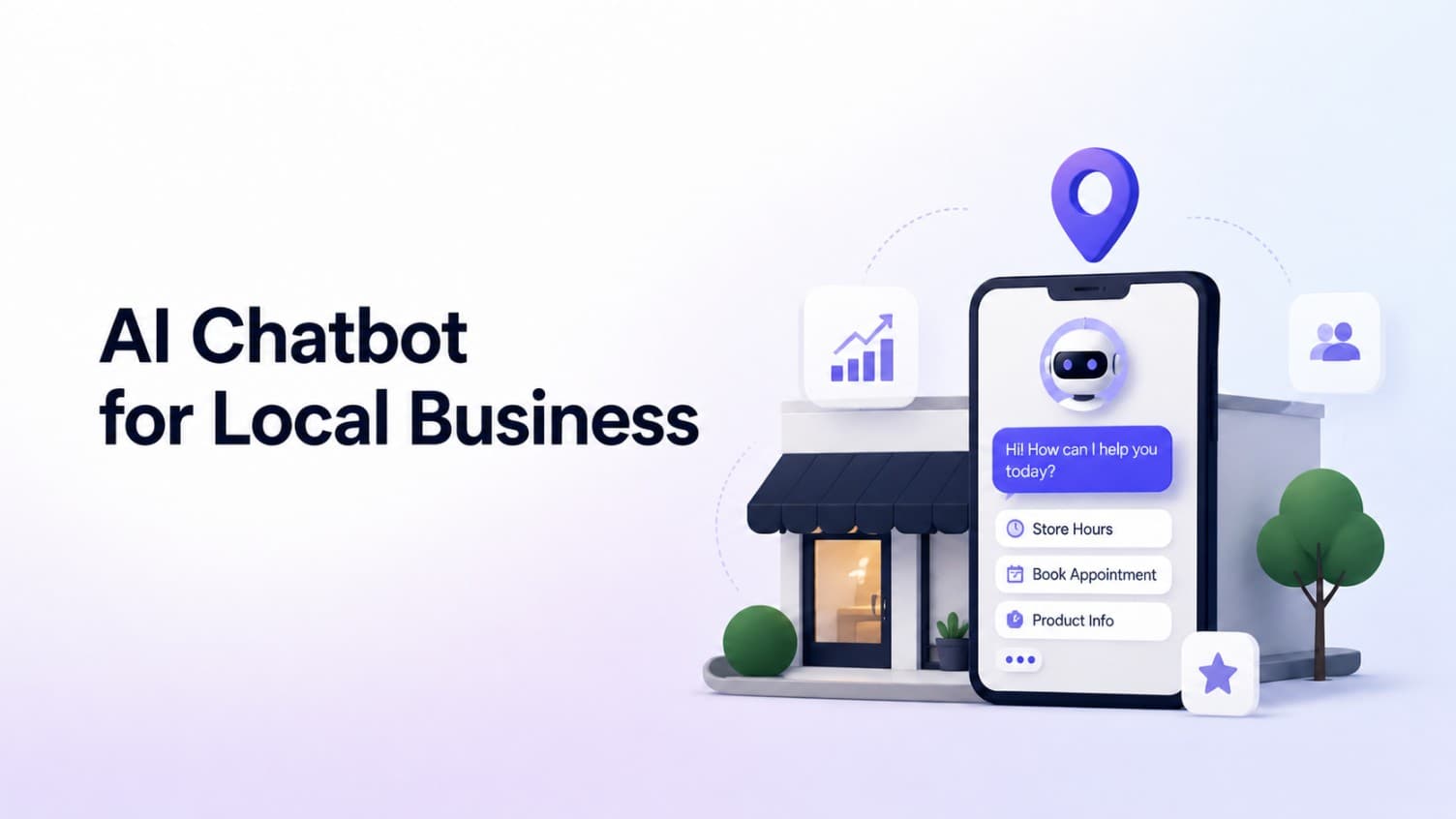
AI Chatbot for Small Local Businesses: A Practical Website Guide
A practical guide to AI chatbots for small business websites: what they answer, where they fit, and how local owners route visitors to booking or quote links.
 Leo Lee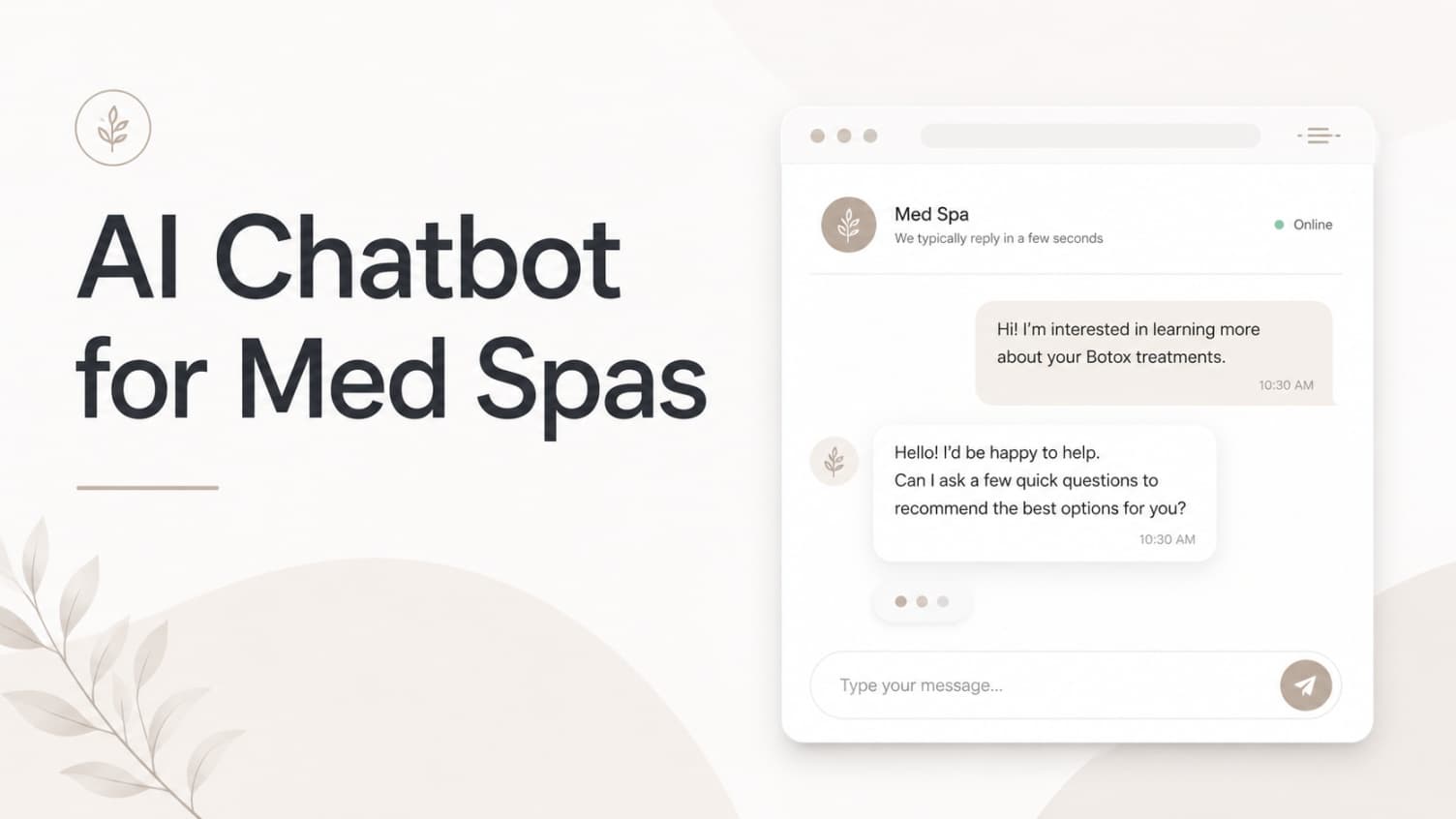
AI Chatbot for Med Spas: Route More Consult Requests from Your Website
A practical guide to med spa website chatbots: answer Botox, filler, laser, pricing, and consult questions, then route visitors to your existing booking path.
Leo Lee
AI Chatbot for Wellness Clinics: Answer First-Visit Questions Faster
A practical guide to wellness clinic website chatbots: answer physio, chiro, massage, pilates, yoga, and IV drip first-visit questions, then route ready visitors to booking or intake.
Leo Lee