Med Spa Chatbot Safety Matrix: Answer, Route, or Refuse
Use this med spa chatbot safety matrix to decide which Botox, filler, laser, pricing, and consult questions AI can answer, route, or refuse.
 Leo Lee11 min read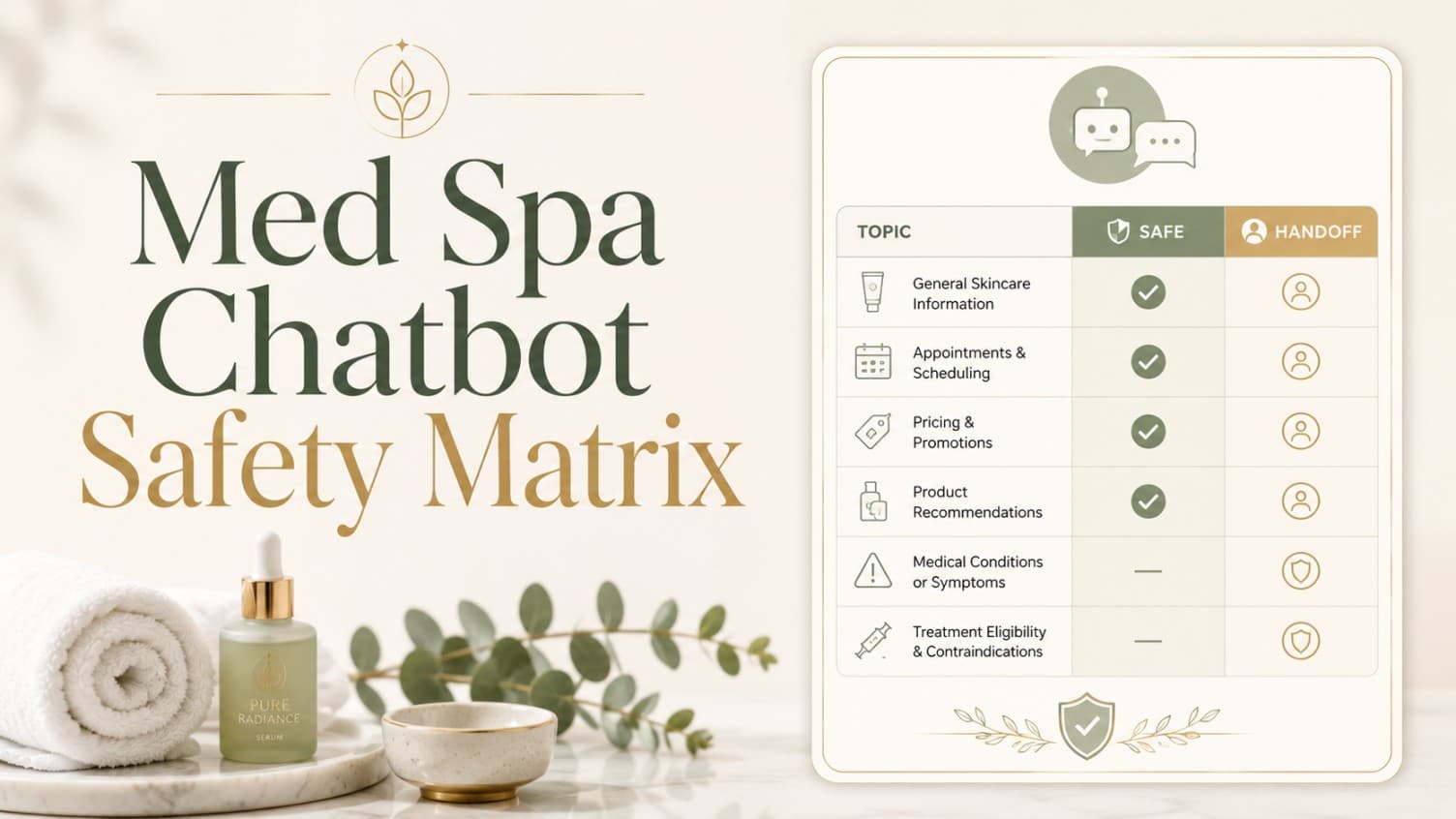
Med spa chatbot safety starts with a simple rule: the AI should answer operational questions, route clinical or personal questions, and refuse questions that ask it to act like a provider.
That is the difference between a useful Website Support Agent and a risky generic chatbot.
A med spa visitor may ask, "How much is Botox?", "Is filler right for me?", "Can I get laser hair removal with my skin type?", or "I had swelling after treatment. What should I do?" Those questions do not belong in the same bucket.
Some can be answered from approved website content. Some should go to a consultation or staff review. Some should stop the AI from continuing and point the visitor to urgent or professional help.
Use this safety matrix before putting a med spa AI chatbot on your website.
Quick answer
A med spa chatbot can safely help with website support when it stays inside approved business information:
- Services offered
- Location, hours, parking, contact details, and booking links
- General consult process
- Published pricing guidance
- Preparation or aftercare links that the clinic already approved
- Policies such as cancellation, deposit, membership, or gift card rules
It should route questions that depend on provider judgment:
- "Am I a good candidate?"
- "Which treatment should I choose?"
- "How many units do I need?"
- "Can I do this while pregnant?"
- "Is this side effect normal?"
- "Can I send a photo?"
It should refuse or stop when the visitor asks for diagnosis, treatment instructions, emergency triage, prescription advice, self-injection guidance, or a guaranteed result.
For the broader med spa workflow, read AI Chatbot for Med Spas. This article focuses only on the safety boundary.
The med spa chatbot safety matrix
Use this answer, route, or refuse matrix as the first draft of your internal rules.
| Question type | Example visitor language | AI should | Staff owns |
|---|---|---|---|
| Basic service info | "Do you offer lip filler?" | Answer from the approved service page and link to the service or consult page. | Update the website when services, providers, or policies change. |
| Booking path | "Can I book Botox online?" | Show the booking or consultation link and explain the next step. | Confirm the actual appointment through the booking system. |
| Published pricing | "How much is filler?" | Give approved pricing guidance, starting ranges, or "priced after consult" language. | Confirm the final treatment plan and price. |
| Treatment fit | "Is laser hair removal right for my skin?" | Route to consultation. Explain that fit depends on provider review. | Evaluate goals, skin, hair, history, and treatment options. |
| Dose, units, or product choice | "How many Botox units do I need?" | Do not estimate. Route to a provider consultation. | Make the recommendation after assessment. |
| Medical history or contraindications | "Can I get this if I take this medication?" | Do not evaluate. Route to staff or formal intake. | Review history through the clinic's approved process. |
| Photos or sensitive details | "Can I upload a photo of my face?" | Only use an approved secure workflow. Otherwise route to staff. | Decide what can be collected, where, and by whom. |
| Side effects or urgent symptoms | "My lips are swollen. Is this normal?" | Stop casual advice and direct the visitor to contact the clinic or seek urgent care if symptoms are severe or urgent. | Handle clinical follow-up and escalation. |
| Guarantees | "Will I look exactly like this photo?" | Avoid promises. Route to consultation and set expectation that results vary. | Discuss realistic goals and risks. |
| Self-treatment or product sourcing | "Can I buy filler online and inject it myself?" | Refuse instructions and route to licensed professional guidance. | Provide appropriate patient education if needed. |
The useful pattern is not "never answer treatment questions." That would make the chatbot frustrating.
The pattern is: answer business information, route provider judgment, and refuse unsafe instructions.
Red-flag questions the AI should not answer directly
Train the chatbot to stop or route when it sees these signals:
- "Am I a candidate?"
- "What should I get?"
- "How many units do I need?"
- "Which filler should I choose?"
- "Can I do this while pregnant or breastfeeding?"
- "Can I do this with my medical condition?"
- "Can I do this with my medication?"
- "Can you diagnose this?"
- "Is this reaction normal?"
- "Should I go to urgent care?"
- "Can I inject this myself?"
- "Where can I buy this product?"
- "Can you guarantee this result?"
- "Can I send photos for you to decide?"
- "What treatment plan do you recommend?"
These questions are not bad leads. They are often high-intent leads. They just need the right path.
For example, "Am I a candidate for filler?" is a buying signal. The chatbot should not answer yes or no. A safer response is:
That depends on your goals, history, anatomy, and provider assessment. The safest next step is a consultation so the team can review fit and explain options.
That keeps the lead moving without turning the AI into the decision-maker.
Safe answer scripts for common med spa questions
The best med spa AI chatbot answers are short. They answer what is known, name the boundary, and show the next step.
Botox or neuromodulator question
Visitor: Do I need a consult before Botox?
Safer answer:
New clients usually start with a consultation so the provider can review goals, medical history, facial movement, and the right appointment type. If you are ready, you can use the consultation booking link here.
This answer does not decide eligibility. It explains the process.
Filler pricing question
Visitor: How much is lip filler?
Safer answer:
Pricing depends on the product, amount used, treatment area, and your goals. If the clinic publishes a starting price, use that approved range. Otherwise, the team can explain expected pricing during consultation before treatment.
For a full pricing article, see Med Spa Pricing Questions.
Laser fit question
Visitor: Will laser hair removal work for my skin type?
Safer answer:
Laser treatment fit can depend on skin, hair, treatment area, device, and provider assessment. The best next step is a consultation so the team can review your goals and explain options.
Post-treatment symptom question
Visitor: I had swelling after filler. Is this normal?
Safer answer:
I cannot evaluate symptoms in chat. Please contact the clinic directly for post-treatment guidance. If symptoms feel severe, urgent, or concerning, seek urgent medical care.
That is not a conversion failure. It is the right boundary.
Refuse scripts that still protect the relationship
A refusal should not sound cold. It should be clear and useful.
Bad refusal:
I cannot help with that.
Better refusal:
I cannot provide treatment instructions or decide whether a procedure is right for you in chat. The team can review that safely through a consultation or follow-up.
Bad refusal:
Please ask your doctor.
Better refusal:
That question depends on your health history and provider assessment. The clinic team can review it through the right intake or consultation process.
Bad refusal:
We do not answer medical questions.
Better refusal:
I can help with services, pricing guidance, booking links, and clinic policies. Questions about symptoms, risks, medications, or treatment fit should go to the provider team.
This is how a medical spa chatbot stays helpful without pretending to be clinical staff.
Privacy boundaries: do not collect more than the website layer needs
Safety is not only about the answer. It is also about what the chatbot asks for.
For website chat, keep pre-consult questions lightweight. Treatment interest, timeline, contact preference, and whether the visitor is new or returning can be useful. Deep medical history, diagnoses, medication details, photos, and identity-heavy information belong in a formal intake process that the clinic has approved.
The HHS minimum necessary guidance describes a privacy principle that protected health information should be limited to what is needed for the purpose. Whether and how HIPAA applies depends on the clinic and workflow, but the practical website-chat rule is still useful: do not ask for sensitive details unless the business has a secure, intentional process for that information.
A good chatbot can say:
I can help route your question, but please do not share detailed medical history here. The team can review that through the proper consultation or intake process.
That line protects the visitor and the business.
Use official safety sources as guardrails, not chatbot copy
Do not train the chatbot to summarize medical risk pages as if it is a provider.
Use official sources to set boundaries.
The FDA's dermal filler page explains that fillers are medical device implants and discusses risks, approved uses, and unapproved uses. The practical chatbot rule is not "teach every filler risk in chat." The rule is "route filler safety, product, and fit questions to a licensed provider."
The CDC's botulinum toxin injection safety guidance tells consumers to ask whether a provider is licensed and whether the product is FDA-approved and from an authorized source. The practical chatbot rule is not "answer clinical Botox questions." The rule is "answer clinic process questions and route provider, product, safety, or eligibility questions to staff."
Source links checked May 31, 2026.
What to train the chatbot on
Train the chatbot on approved, customer-visible information:
- Service pages
- Pricing page or pricing policy
- Consultation process
- Booking links
- Staff contact paths
- Cancellation and deposit policies
- Prep and aftercare pages that the clinic has approved for public use
- Provider pages and credentials that are already public
- FAQ pages reviewed by the clinic
- Location, hours, parking, and accessibility details
Do not train the website chatbot to invent:
- Eligibility rules
- Dose recommendations
- Product selection
- Medical intake decisions
- Treatment plans
- Emergency guidance
- Exact outcomes
- Exact final prices when the clinic has not approved them
If the source content is weak, fix the source content first. A chatbot trained on vague or risky copy will repeat vague or risky answers.
For examples of source material, see Med Spa Website FAQ Examples. For lightweight routing questions, see Med Spa Lead Qualification.
Where CatchWhen fits
CatchWhen is not trying to make the AI act like a provider.
It builds a business-specific Website Support Agent that answers from approved website knowledge and routes visitors to the next step the clinic already uses: booking link, consult request, phone call, email, or staff review.
That matters for med spa chatbot safety because the goal is not more conversation. The goal is better routing.
The AI should handle the first layer:
- "Do you offer this?"
- "How do I book?"
- "Where are you located?"
- "What does the consultation process look like?"
- "Where can I see pricing guidance?"
- "Can someone follow up with me?"
The team should handle the clinical and personal layer:
- "Is this right for me?"
- "What product should I get?"
- "How much do I need?"
- "What does this symptom mean?"
- "Can you review my medical history?"
That division is the safety design.
FAQ
Can a med spa chatbot answer Botox questions?
Yes, but only within approved business information. It can explain whether the clinic offers Botox or neuromodulators, how consultation booking works, and where to find pricing guidance. It should not decide candidacy, estimate units, discuss medication risk, or provide clinical advice.
Can a med spa chatbot answer filler pricing questions?
Yes, if the clinic has approved pricing language. The chatbot can share starting ranges, "priced after consult" language, or factors that affect pricing. It should not promise a final price before provider review.
Is a med spa chatbot a HIPAA compliance risk?
It can be if the workflow collects or processes sensitive health information without the right controls. The safer website-chat design is to ask lightweight routing questions, avoid deep medical history in casual chat, and send sensitive details to the clinic's approved intake or staff-review process. Clinics should review privacy and compliance requirements with qualified advisors.
What is the safest first version of a med spa AI chatbot?
Start with services, hours, location, booking links, pricing guidance, policies, and consultation routing. Add clear rules for provider questions, symptom questions, photos, medical history, and human handoff before launch.
Takeaway
A safe med spa chatbot does not need to sound like a provider.
It needs to know where the website answer ends.
Answer the approved business question. Route the consult question. Refuse unsafe medical instructions. That is the operating system behind a useful med spa AI Support Agent.

Article by
Leo Lee
Leo Lee is the founder and builder of CatchWhen, a Customer Support AI System that creates AI Support Agents for appointment-based local businesses. CatchWhen helps med spas, salons, wellness clinics, and other independent service businesses answer customer-facing website inquiries and route ready leads into the booking, quote, or contact tools they already use. Leo writes about the workflows, guardrails, and infrastructure behind production-ready AI customer support agents.
Keep reading

AI Chatbot for Small Local Businesses: A Practical Website Guide
A practical guide to AI chatbots for small business websites: what they answer, where they fit, and how local owners route visitors to booking or quote links.
 Leo Lee
AI Chatbot for Med Spas: Route More Consult Requests from Your Website
A practical guide to med spa website chatbots: answer Botox, filler, laser, pricing, and consult questions, then route visitors to your existing booking path.
Leo Lee
AI Chatbot for Wellness Clinics: Answer First-Visit Questions Faster
A practical guide to wellness clinic website chatbots: answer physio, chiro, massage, pilates, yoga, and IV drip first-visit questions, then route ready visitors to booking or intake.
Leo Lee