AI Employee vs Human Staff: Decision Matrix for Local Businesses
Use this AI employee vs human staff decision matrix to decide what local businesses should automate, keep human, or handle with a hybrid workflow.
 Leo Lee11 min read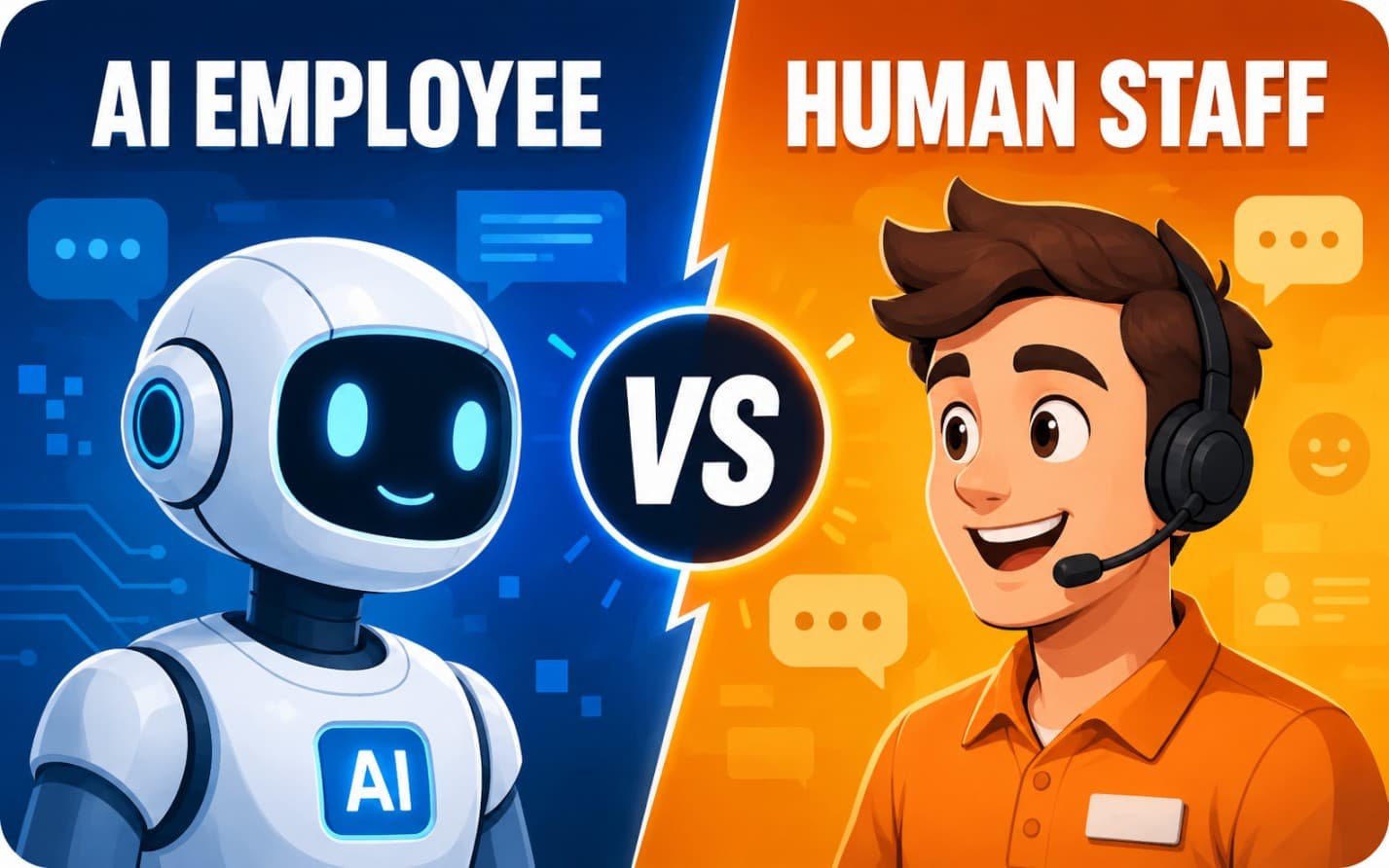
An AI employee should not be treated like a cheaper human employee.
That framing is tempting, but it leads to bad customer support design. A local business does not need an AI pretending to be a receptionist, manager, provider, estimator, and policy decision-maker at the same time.
The better question is:
Which customer support tasks should AI handle first, which should stay with human staff, and which should use both?
That is where the comparison becomes useful.
For appointment, consultation, and quote-based local businesses, AI is strongest when it handles repeatable first-response work: answering approved questions, collecting details, routing customers, and handing off when judgment is needed. Human staff are still needed for trust, exceptions, sensitive questions, final decisions, and relationship-heavy conversations.
Quick answer: AI employees handle speed, human staff handle judgment
Use an AI employee for tasks that are frequent, structured, and safe to answer from approved information.
Use human staff for tasks that require judgment, empathy, authority, or accountability.
Use a hybrid workflow when the customer needs a fast first response but a person still needs to make the final call.
That is the practical split.
Gartner reported in April 2026 that many service and support leaders are expanding human agent responsibilities despite expectations of AI-driven layoffs. The useful takeaway is not that every small business needs an enterprise AI strategy. It is that AI often changes the human role instead of removing it.
For a local business, the human role becomes less about answering the same basic question all day and more about reviewing the cases that actually need a person.
Source links in this article were checked May 19, 2026.
The AI vs human staff decision matrix
Use this matrix before you buy software or redesign staff workflows.
| Customer support task | AI employee | Human staff | Best workflow |
|---|---|---|---|
| Answering hours, services, location, and basic policies | Strong fit | Backup only | AI answers from approved business content. |
| Explaining starting price ranges or what affects pricing | Good fit with limits | Reviews edge cases | AI shares approved pricing guidance and routes exact quote questions. |
| Helping a customer choose the right booking path | Good fit for simple cases | Needed for complex cases | AI asks clarifying questions, then routes uncertain cases to consultation. |
| Collecting quote or consultation details | Strong fit | Reviews and follows up | AI collects context before the team calls back. |
| Handling complaints or angry customers | Poor fit alone | Strong fit | AI acknowledges and routes quickly to a person. |
| Approving refunds, exceptions, discounts, or policy changes | Not a fit | Required | AI can explain standard policy but cannot approve exceptions. |
| Deciding medical, legal, financial, or safety questions | Not a fit | Required | AI should hand off immediately. |
| Building trust with nervous or high-value customers | Support role | Required | AI answers basics, then makes it easy to reach a person. |
| Reviewing repeated questions after launch | Good support role | Required | AI surfaces patterns; staff decide what to change. |
The pattern is simple: AI is useful when the business already knows the answer and the next step. Human staff are necessary when the business needs to decide, interpret, reassure, approve, or take responsibility.
What AI staff are best at
AI staff are best at the work humans repeat constantly.
For a local business, that often includes:
- "Are you open today?"
- "Do you offer this service?"
- "How much does it usually cost?"
- "Do I need a consultation first?"
- "Which appointment should I choose?"
- "Can I request a quote?"
- "Can someone call me tomorrow?"
- "Where do I book?"
These questions sound small, but they matter because they often happen right before a customer books, requests a quote, or leaves.
A good AI Support Agent can answer the safe part quickly and route the customer to the next action.
Example:
"I am not sure which facial to book."
Bad AI answer:
We offer many facial services designed to help your skin look its best.
Better AI answer:
If you are unsure which facial to choose, start with a consultation or first-time client option. If you already know the service you want, you can book here.
The better answer does not try to become a provider. It reduces confusion and moves the customer forward.
What human staff should keep
Human staff should keep the work where the business needs judgment or accountability.
That includes:
- treatment eligibility
- exact quotes that require review
- refunds and disputes
- policy exceptions
- complaints
- high-emotion conversations
- outcome promises
- anything medical, legal, financial, or safety-related
- final approval for unusual requests
A med spa AI employee should not decide whether someone is a good candidate for a treatment. A salon AI employee should not promise that a color correction will turn out a certain way. A home service AI employee should not guarantee an exact quote from a vague message.
Bad AI answer:
Yes, you are a good candidate for that treatment.
Better AI answer:
I cannot determine treatment fit in chat. The safest next step is to book a consultation or contact the clinic so the provider can review your situation.
Human staff are not just there for the leftover work. They are there for the moments where trust can be won or lost.
The strongest setup is usually hybrid
The best setup is not AI vs human.
It is AI before human.
For many local businesses, the useful workflow looks like this:
- Customer asks for help.
- AI answers the first safe question from approved content.
- AI collects context if the customer needs follow-up.
- AI routes to booking, quote, call, email, or contact.
- AI hands off sensitive questions to staff.
- Staff review the conversation with context already attached.
- Repeated questions improve the source content, FAQ, or routing rules.
That is a support workflow, not a replacement fantasy.
It also matches how small teams actually work. The owner may be with a client. The front desk may be on another call. The technician may be on-site. The customer still expects a first response.
AI can cover that first response. Human staff should own the decision.
When an AI employee should answer alone
Let AI answer alone when all four conditions are true:
- The answer is already approved.
- The question is low-risk.
- The next step is clear.
- A wrong answer would be annoying, not dangerous or expensive.
Examples:
- business hours
- parking information
- service area
- basic service descriptions
- how to book
- where to request a quote
- what to bring to a first visit
- how to contact the team
This is where AI saves staff time without creating much risk.
The SBA's AI guidance for small businesses recommends starting small, testing tools, reviewing AI output, and protecting customer trust. That advice maps well to AI staff: start with the work that is clear, repeatable, and easy to review.
When a human employee should step in
Human staff should step in when any of these are true:
- the customer is upset
- the answer could create liability
- the customer needs a personalized recommendation
- the request involves money, refunds, or exceptions
- the AI does not have enough information
- the business has not approved a standard answer
- the customer explicitly asks for a person
The handoff should not feel like a dead end.
Weak handoff:
Please contact us.
Better handoff:
This needs team review. Please share your name, appointment or service details, and the best way to reach you so a person can follow up.
The better handoff still saves time. Staff receive context instead of starting from nothing.
Common mistakes when comparing AI employees and human staff
The first mistake is asking whether AI is "better" than a person.
That is too broad to be useful.
Ask whether AI is better for this specific task, with this source content, this risk level, and this handoff path.
Other mistakes:
- giving AI authority it does not have
- hiding the human path
- using AI before fixing vague source content
- measuring only response speed, not next-step completion
- letting AI answer sensitive questions too confidently
- buying a large platform when the real leak is repeated first-response questions
- expecting staff to trust AI without a review loop
Sinch's 2026 AI Production Paradox research reported rollbacks of enterprise AI communication agents tied to governance failures. Local businesses do not need enterprise governance layers, but they do need the simple version: approved answers, boundaries, testing, and review.
Where CatchWhen fits
CatchWhen is not positioned as a full AI employee that replaces your team.
It is a Customer Support AI System that currently starts with a Website Support Agent for website inquiries.
In this article's framework, CatchWhen belongs in the first-response and routing role before your staff step in, not in the human replacement role.
It can help with:
- answering common customer questions from approved website, FAQ, and business content
- routing customers to booking, quote, call, email, or contact paths
- collecting useful context before follow-up
- keeping sensitive questions pointed toward a person
- showing which source content or process should answer repeated questions better
It does not replace licensed providers, front-desk judgment, refunds, exceptions, exact quotes, or final customer relationship work.
If you are deciding between a generic chatbot and a more structured support workflow, use the AI chatbot vs AI Support Agent decision matrix. If you want a broader automation map, read how people automate customer support in 2026.
FAQ
Can an AI employee replace a human employee?
For most local businesses, not completely. AI can handle repeatable first-response work, but human staff are still needed for judgment, exceptions, trust, sensitive questions, and final decisions.
Is an AI employee the same as an AI agent?
Not always. "AI employee" is often a marketing term. An AI agent usually describes software that can perform a defined task or workflow. For local businesses, the safer question is what the AI is allowed to answer, route, collect, or hand off.
Should I use AI for customer service before hiring staff?
Use AI first if your main problem is repeated first-response questions, after-hours inquiries, or missed support moments. Hire or rely on human staff when the work requires judgment, relationship-building, or operational authority. If you are evaluating CatchWhen specifically, its current starting point is website inquiries.
What should an AI employee never handle alone?
It should not handle medical, legal, financial, or safety advice, eligibility decisions, refunds, policy exceptions, outcome promises, exact quotes without review, or angry customer situations without a human handoff.
Takeaway
The useful comparison is not AI employee vs human staff.
The useful comparison is task by task.
Let AI handle speed, repetition, intake, and routing. Keep humans responsible for judgment, empathy, exceptions, and trust. The strongest customer support setup for a local business usually uses both.

Article by
Leo Lee
Leo Lee is the founder and builder of CatchWhen, a Customer Support AI System that creates AI Support Agents for appointment-based local businesses. CatchWhen helps med spas, salons, wellness clinics, and other independent service businesses turn missed customer questions into clear first responses, starting with website inquiries that route ready leads into the booking, quote, or contact tools they already use. Leo writes about the workflows, guardrails, and infrastructure behind production-ready AI customer support agents.
Keep reading
AI Chatbot for Small Local Businesses: A Practical Website Guide
A practical guide to AI chatbots for small business websites: what they answer, where they fit, and how local owners route visitors to booking or quote links.
 Leo Lee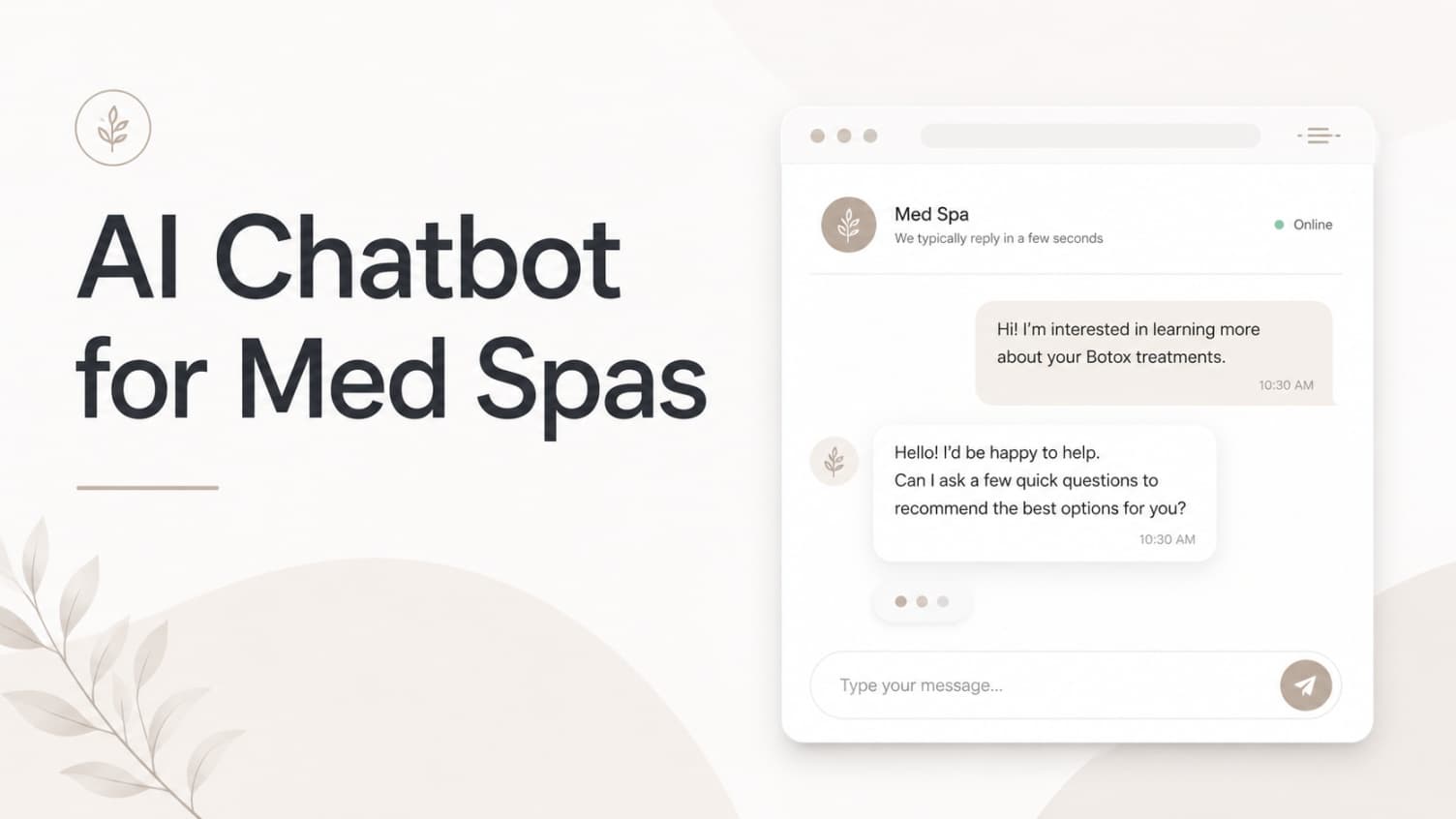
AI Chatbot for Med Spas: Route More Consult Requests from Your Website
A practical guide to med spa website chatbots: answer Botox, filler, laser, pricing, and consult questions, then route visitors to your existing booking path.
Leo Lee
AI Chatbot for Wellness Clinics: Answer First-Visit Questions Faster
A practical guide to wellness clinic website chatbots: answer physio, chiro, massage, pilates, yoga, and IV drip first-visit questions, then route ready visitors to booking or intake.
Leo Lee